
If you’re like us, you probably have a few kitchen appliances on your counter or in your pantry that you rarely use. Maybe you got excited by the automatic potato peeler, or the dragon fruit slicer, or you were intrigued enough to purchase a “gelato extruder” – you never know, it could be real.
But those appliances sit unused in the back of all our cupboards, waiting for the once-in-a-year opportunity to be used.
A food dehydrator is not like that. It’s one of those appliances that will get as much use as your toaster, your microwave, or your coffee percolator. Your food dehydrator is your new best friend.
You know all those fruits and vegetables wasting away in the crisper of your fridge? There’s no way you’ll ever eat 2lbs of pumpkin before tomorrow, so what will you do? You hate to waste it, but you can’t manage to eat it.
You can always preserve it for when you’re ready. A food dehydrator serves as a simple way to make your fresh produce last longer without spoiling or turning rotten. You don’t have to wait for the next berry season to have fresh strawberries. You can have them year round if you’ve preserved them.
Our Top 5 Picks
Article NavigationWhat Can You Do With Your Food Dehydrator?Buying GuideThe SciencePreserving FoodThe Features✓ Shelves/Stacks✓ Thermostat✓ Even Airflow✓ CapacityTop 5 Food Dehydrators ComparedNesco FD-75A Snackmaster Pro Food DehydratorPresto 06301 Dehydro Digital Electric Food DehydratorExcalibur 3926TB Food DehydratorCuisinart DHR-20 Food DehydratorMAGIC MILL Food Dehydrator BundleYou’re All Dried Up
What Can You Do With Your Food Dehydrator?
Are you worried that you won’t have enough use for the dehydrator? Don’t be. This will pay for itself again with the number of times you’ll pull it out.
You can:
- Preserve berries
- Dry out peaches
- Create crispy nuts
- Prepare granola and trail mixes
- Make your own fruit leather
- Dehydrate mushrooms
- Make your own kale chips
- Ferment homemade yogurt (dairy-free of course)
- Create dried tomatoes for cooking
This is just the first week. You’ll never run out of ideas when you own your food dehydrator. You’ll ask yourself, “Could I preserve this?” when out at the supermarket, and more often than not, the answer will come back ‘Yes’.
Buying Guide
It can be daunting to try and select a food dehydrator if you’re unfamiliar with the appliance. When you first look for a unit, you’ll get bombarded with phrases like Stackable, Box-and Shelf, Closed System, Square Footage, Vertical/Horizontal design, and wattage/temperature.
These can get confusing when you’re still learning how you’ll use one. So let us guide you as you decide on your best food dehydrator.
The Science
With a product this popular, there’s enough science to back up the reasons for making the purchase. But before we get into the ‘How’ of the machine, let’s talk about the “Why.”
The main reason you want to dehydrate your food is to preserve the natural vitamins and minerals in the food without getting any spoilage. The main reason food spoils is the presence of moisture and most foods have moisture in it – anywhere from 2% to 96% moisture.
It’s not that the actual moisture in the food causes the food to go bad but the presence of moisture means that bacteria and fungus can grow in that environment. You can’t get rid of bacteria in your environment, but you can limit where it can grows.
You know how it was a big deal that we found water on Mars not too long ago? Because that’s the best sign that life can exist. No water? No life. Simple as that.
So, the same principle applies on a micro scale on your food. As long as you can find a way to stop bacteria from growing, you can extend the life of your food for 6 months, one year, even up to 5 years!
Preserving Food
There are a few methods to preserving foods and extending its shelf life. They may vary considerably, but the main purpose is always the same; stop bacterial growth.
If you can find a way to keep bacteria from contacting and thriving on your food, you can preserve it.
One of the most common ways is to freeze your food. By putting your food into a sub-zero environment, nothing can grow on it. But this takes up space in your freezer and requires constant power. What happens if you want to take food with you, say on a hike? As soon as you remove food from the freezer, you start the timer as to when it will thaw and start to go rotten.
Another way is to can your fruits and vegetables. Canning involves submerging your fruits and vegetables in some sort of brine or liquid, trapping them in an oxygen-free environment. If you can’t remove the liquid, remove the oxygen that bacteria need to breathe. Think about pickles, peaches, jams, jellies, and even Korean kimchi. Preserved vegetables in vinegar brine can ferment and preserve the food for up to 3 years in a simple clay pot. Fermenting and preserving food this way takes space and effort to create an effective brine or canning liquid.
The best method, and certainly the easiest for any home owner, is to dehydrate the food. You can preserve the food as long as required in a cupboard or fridge. And when you’re ready to eat it, you can either open up the bag and start munching, add it to your cooking, or rehydrate the food to enjoy it as it once was.
The best method for preserving food is heated air that force-dries the moisture from the food, retaining the food’s structure and nutrients. The air is heated to anywhere between 90-150° Fahrenheit with a fan blowing the air across the surface of the food. The moisture is forced out by the heat and blowing air, while the food remains preserved and intact.
The benefit of using this food dehydration method is that you aren’t restricted by volume. You can dry as much, or as little, as you need. Dry out a couple of tomatoes, or stack up this season’s crop of fresh berries to dehydrate until you’re ready for them months down the track.
The Features
Of course, every food dehydrator is going to remove the moisture from the food. But you’ll find a whole host of other features on different models. Let’s take a look at what you should and shouldn’t look for on your dehydrator.
✓ Shelves/Stacks
When buying food dehydrators, check to see if you stack the food on top of each other, or you have shelves. You’ll find advantages to both, and we’re not here to advise one way or the other. It entirely depends on how much you’ll use the product.
Vertical shelves make use of a sideways fan, usually mounted in the back of the unit. It blows air smoothly and evenly across all shelves. The real advantage to using a shelving system is that you can easily check different sections of the dehydrator. If you want, you can put different fruits and vegetables on each level, checking each shelf as they go. There’s no need to disassemble the entire unit just to check the tomatoes or the mushrooms.
The other option is the stackable vertical units. The fan blows from the bottom and reaches all the way through each stack. If you choose this option, you can stack as few or as many levels as you want. Many brands offer the ability to add additional shelves if you’d like to increase the capacity. But the top layers and bottom layers don’t get an even amount of air. You might need to experiment to find the right ratio for where best to put your foods for good results.
✓ Thermostat
Try to find a model with an adjustable thermostat. You’ll most likely use the food dehydrator to dry out several different types of foods. But each food is best preserved at different temperatures. For example, if you’d like to dry out some of those herbs you have that you can’t use, you only need to set it at a low temperature around 95 degrees Fahrenheit. But if you want something more aggressively dried out, such as fish or fruits, you can set the temperature at 135 degrees Fahrenheit.
You can’t even dry out different foods, so find a model that has a thermostat to set your desired temperature. Furthermore, look for a dehydrator that has a high range of temperature so that you have more options. You’ll get an even result, and a great product after the food is preserved.
✓ Even Airflow
Take some time to check out the fan size of different models. The size of fan determines how even the air will flow across the surfaces.
Depending on the vertical or horizontal model, it should have a good sized blade that can fan across all surfaces evenly. There’s nothing worse than having the food at the back complete while the food at the edge is still moist. Just like Pearl Jam tells us, you want even flow. Look for blades that are large, around 7” in diameter or more.
✓ Capacity
The capacity of your machine determines different variables. You’ll have the ability to dry more food, but it will use more wattage to power the unit.
Bigger units can handle large capacities, up to 31 square footage of drying space, but the wattage can be high as well. We’ve seen models with 1000+ watt requirements. If you’re going to use this size food dehydrator often, it could be worthwhile, especially if you’re preserving entire boxes of tomatoes, fresh cherries or peaches.
Otherwise, you might want to find a smaller unit. You won’t be able to fit as many foods into the machine, but you can easily store the unit away and power it without breaking the bank on your utility bill. You can still do fruit leathers and homemade kale chips, but a smaller capacity doesn’t have the space needed for a big trip to the farmer’s market.
Top 5 Food Dehydrators Compared
We’ve collated the best dehydrators on the market, and as you can see, there are plenty of options to choose from. Let us break down theses options so you can decide which food dehydrator will work for you.

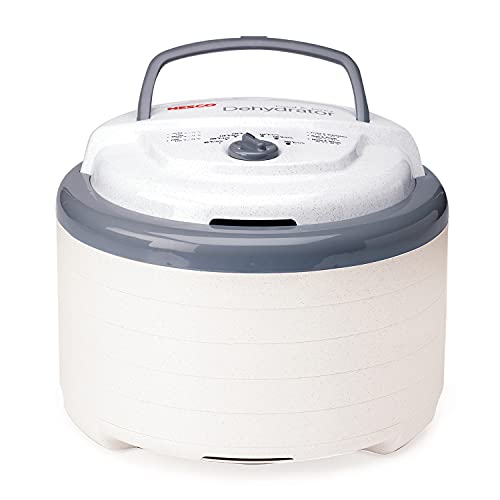
Nesco FD-75A Snackmaster Pro Food Dehydrator
Best for Beginners
The Nesco Snackmaster is a highly popular brand online. It’s garnered praise from thousands of satisfied customers, and we can see why.
The brand is well trusted in the food dehydration world. Nesco has quite a few different models available, but we chose the 75A for its wide market appeal. It works for casual beginners as well as heavy users.
The vertical stacking trays come with a set 5 levels, but you have the option of purchasing more if you need. The 600 Watt unit can comfortably handle up to 12 trays for an exceptional amount of drying. It will also keep out the UV rays for more effective preserving of your fruits and vegetables.
Adjust the temperature on the handy thermostat. It regulates the interior temperature while the top mounted fan blows the air downwards over the food. The science of the top fan doesn’t make sense to us. Hot air rises, and so it seems counter-intuitive to place the fan at the top.
It also comes at quite an affordable price. If you’re just getting into dehydration, it’s not an expensive way to begin. You’ll make your money back from the preserved food and reduced wastage in the first month if you use it enough.
What We Liked
- The adjustable thermostat
- The added trays for additional food dehydrating
- UV blocking sides
- Simple instructions and usages – good for beginners
- Great reviews online
What We Disliked
- Opaque sides don’t allow us to see the progress of dehydration
- Top mounted fan blows hot air downwards. Seems gimmicky when hot air naturally rises.
- If drying multiple varieties of foods, stacks must be re-arranged midway